
From 1 July 2026, businesses and organisations sending SMS/MMS messages to Australian mobile numbers using an alphanumeric Sender ID will need to make sure that Sender ID is registered in the Australian SMS Sender ID Register under new industry requirements introduced by the Australian Communications and Media Authority (ACMA).
An alphanumeric Sender ID is the name that appears at the top of an SMS instead of a mobile number. For example, a customer may see your business name, brand name or service name as the sender of the message.
Baycall Pty Ltd trading as 160.com.au is a participating telecommunications provider in the SMS Sender ID Register and can assist eligible customers with Sender ID registration applications. 160.com.au is an Australian bulk SMS provider based in Sydney, operating since 2000.
Register Your Sender ID
If you send SMS or MMS messages using a business name, brand name or other alphanumeric Sender ID, we recommend starting your registration as early as possible.
Waiting until the 1 July 2026 deadline may put your SMS delivery at risk if your registration has not been completed in time.
To register your Sender ID through 160.com.au, log in to your account and go to the Sender ID Registration section, or contact our support team for assistance.
What Is The SMS Sender ID Register?
The SMS Sender ID Register is an Australian system designed to reduce SMS impersonation scams.
It helps verify which businesses and organisations are authorised to use specific Sender IDs when sending messages to Australian mobile numbers.
The aim is simple: if a message shows a business or brand name, there should be a proper link between that Sender ID and the entity using it.
This helps protect businesses from impersonation and helps customers identify whether an SMS is more likely to be from a genuine sender.
Who Needs To Register?
You should register your Sender ID if you send SMS/MMS messages to Australian mobile numbers using a name instead of a number.
This may include:
- your business name
- your company name
- your trading name
- your brand name
- your service name
- an abbreviation of your business or brand
- any other alphanumeric Sender ID
If you send messages using a standard mobile number or virtual number, this Sender ID registration requirement does not apply to that number.
What Happens If You Do Not Register?
From 1 July 2026, if an SMS/MMS message is sent to an Australian mobile number using an alphanumeric Sender ID that is not registered, the Sender ID may be labelled as:
Unverified
This means your customer may no longer see your usual Sender ID. Instead, the message may appear as coming from “Unverified”.
Unregistered Sender IDs may also be more likely to cause confusion, reduce customer trust or be affected by carrier handling rules.
To avoid disruption, we recommend registering every Sender ID you want to keep using before the deadline.
How To Register Your Sender ID With 160
We can help eligible customers submit Sender ID registration applications and understand what information is required.
Using 160.com.au can help make the process easier because we already understand SMS delivery, Sender IDs, business messaging and the information generally needed to support an application.
We can help you check:
- which Sender IDs you currently use
- whether your Sender ID appears to match your business
- what evidence may be needed
- whether your Sender ID may need to be changed before applying
- whether a virtual number may be a better option for your use case
Submitting an application does not guarantee approval. A Sender ID may be rejected by 160.com.au, ACMA or the Register process if the required checks cannot be completed or if the Sender ID does not meet the applicable requirements.
Step 1 — Identify every sender ID you use
Check your SMS platform and list every distinct sender name you use across campaigns, reminders, alerts, and notifications. Each name is a separate sender ID and if you wish to use the sender ID after 1 July 2026 each one must go through its own registration. A single approval does not cover multiple sender IDs.
Step 2 — Documents required for sender ID registration
Before you begin the application you will need:
- Your ABN — entered in full. Shortened or partial ABNs are rejected.
- Your registered business or company name — as it appears exactly in the Australian Business Register (ABR)
- An authorised representative — a senior person in your organisation whose details can be matched against ABR records
- Proof of association — evidence linking your sender ID to your business. Accepted forms include a matching registered business name, company name, IP Australia trademark (or equivalent international register), or a domain name listed in WHOIS
Your details must be current on the ABR to register a Sender ID
To register a Sender ID using an Australian Business Number (ABN), your authorised contact
or service of notice email address in the Australian Business Register (ABR) must be up to date.
ACMA does not check Relationship Authorisation Manager (RAM) for authorisation arrangements
for the SMS Sender ID Register.
Step 3 — Submit through our sender ID portal
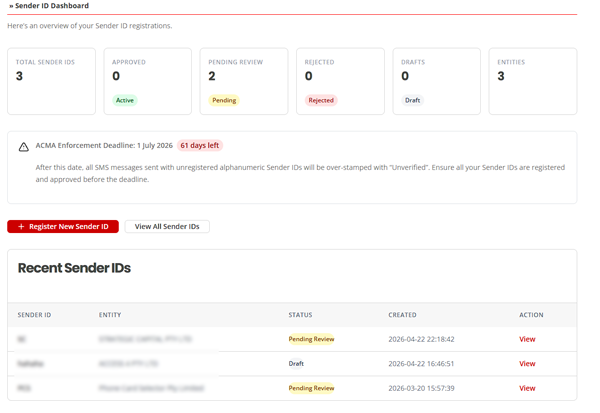
Businesses with an ABN can apply via an approved participating telecommunications provider like 160.com.au. If your business does not have an ABN — for instance, if you are based overseas and sending into Australia — you must go through an approved certified provider. You cannot self-register with ACMA in that case.
To register through 160.com.au, log in to your account and navigate to the Sender ID Registration section, or call 1800 671 823 and our team will help you through it.
Step 4 — Allow time for review
ACMA reviews each application individually. Processing times are not guaranteed. This is the reason we recommended applying as soon as possible and, not applying on 1 July 2026. Submitting close to the enforcement date risks your approval not coming through in time.
Who Can Apply To Register A Sender ID?
The following types of entities may be approved to apply to register Sender IDs:
- an individual
- a body corporate
- a corporation sole
- a body politic
- a government entity
- a partnership
- an unincorporated association or body of persons
- a trust
- a superannuation fund
Entities With An ABN
An entity with an ABN can apply to register its Sender ID through any participating telecommunications provider that is an originating telecommunications provider like 160.com.au, or through a partner of a participating telecommunications provider.
To make an application, the person requesting the registration must usually:
- be listed as an authorised contact for the entity on the Australian Business Register, or otherwise be authorised by the entity
- pass an identity check
- agree to the Register’s terms of use
After the application is submitted, the authorised representative may receive instructions from ACMA about how to access the Register.
Once the entity is approved by ACMA, the entity may need to confirm the Sender ID registration.
Entities Without An ABN
An entity without an ABN can only apply to register a Sender ID through an originating telecommunications provider that is a certified telecommunications provider, or through a partner of a certified telecommunications provider.
This may apply to overseas businesses that send SMS/MMS messages to Australian mobile numbers using a named Sender ID.
The provider or partner will need to complete checks to confirm:
- the identity of the person making the request
- that the person is authorised to act for the entity
- that the entity is officially recognised or certified in its country
- that the entity has a valid use case for the Sender ID
Non-ABN entities that register through a certified provider or partner will not be given direct access to the ACMA Register.
If your business is based overseas and you send SMS/MMS messages into Australia using a named Sender ID, contact 160.com.au to discuss your options.
Can You Use The Same Registered Sender ID With Another Provider?
Registering a Sender ID through 160.com.au does not mean you can only use that Sender ID with 160.com.au.
Once your Sender ID is registered, you may authorise other participating telecommunications providers to send messages using that Sender ID.
Your Sender ID registration is not locked to the provider that helped submit the application.
Registration Costs
160.com.au does not currently charge a separate Sender ID registration fee. However, standard SMS service charges continue to apply.
If any ACMA, Register or annual charges apply in the future, these will be communicated to customers before being charged.
What your sender ID must look like to be approved
Not all sender IDs will pass the review. Generally the following rules apply:
Sender ID Format
Sender IDs must be short and clear.
As a general guide, a Sender ID should:
- be between 3 and 11 characters
- contain at least one letter
- use letters and/or numbers
- not be purely numeric
- not impersonate another business or organisation
- not mislead recipients
A Sender ID should help recipients understand who the message is from.
Generic names such as Support, Info, Admin, Alert or Notice are unlikely to be accepted unless they are clearly connected to your organisation in a permitted way.
What Information Is Required?
To register a Sender ID, you will usually need to provide information that shows your business or organisation has a valid use case for that Sender ID.
This may include:
- your ABN, if you have one
- your registered business name
- your company name
- your registered trademark
- your registered domain name
- details of the authorised person making the application
- a description of how the Sender ID is used
- evidence linking the Sender ID to your business or organisation
The Sender ID must be traceable back to the entity that wants to use it.
What Is A Valid Use Case?
A valid use case means there is evidence showing that the Sender ID relates to, or is owned by, the entity applying for it.
For an entity with an ABN, the Sender ID generally needs to match, shorten, abbreviate or be an acronym or initialism of one of the following:
- the entity’s registered business name
- the entity’s company name
- a registered trademark owned by the entity
- a registered domain name for which the entity is the registrant
The Sender ID may also include words connected to the entity’s function, location or the purpose of the message.
For example, a business called ABC Furniture Pty Ltd may be able to apply for Sender IDs connected to its business name, company name, registered trademark or registered domain name.
Examples
These examples are general only. Actual approval depends on the information provided and the checks completed during the application process.
| Sender ID | Possible Outcome | Reason |
|---|---|---|
| ABCFurn | Likely acceptable | Abbreviation of ABC Furniture |
| ABCFurnAU | Likely acceptable | Abbreviation plus location |
| AFPL | May be acceptable | Initialism of ABC Furniture Pty Ltd |
| ABCSupport | May be acceptable | Business name plus message purpose |
| Support | Not likely acceptable | Too generic by itself |
| PayPal | Not acceptable | Appears to impersonate another entity |
Product, Service And Brand Names
A product, service or brand name may be accepted only where it can be properly linked to the entity applying for the Sender ID.
This link may come from an approved evidence source such as:
- a registered business name
- a company name
- a registered trademark
- a registered domain name
Simply selling another company’s product does not automatically give a business the right to register that product or brand as its Sender ID.
For example, a retail shop that sells a well-known brand does not automatically have the right to register that brand name as its own Sender ID. The business would generally need to use a Sender ID connected to its own business, company, trademark or domain name, unless it has proper authorisation from the relevant entity that is authorised to use that brand.
Frequently asked questions
What is an alphanumeric sender ID?
It is the label that shows at the top of a text message conversation instead of a phone number. When a recipient sees a word like “CommBank” or “AusPost” at the top of a thread, that word is the alphanumeric sender ID. If your business sends SMS with a name showing instead of digits, you are using one.
I send from a virtual number. Am I affected?
No. The register covers named sender IDs only. Virtual numbers — which appear as standard mobile numbers — are not subject to this requirement and do not need to be registered.
My business is based overseas. Do I need to comply?
Yes, if you are sending messages to Australian mobile numbers using a named sender ID. Location of your business does not affect the obligation. Because you will not hold an ABN, you must work with a certified Australian telecommunications provider to register. Call 1800 671 823 to discuss your options.
Can I keep sending normally until 1 July 2026?
Yes. Nothing changes for your messages before the enforcement date. The “Unverified” flag and potential carrier filtering only apply from 1 July 2026 onwards. That said, we recommended applying as soon as possible so ACMA has time to process your registration before enforcement begins.
Can I register more than one sender ID?
Yes, but each one requires a separate application. If you use different sender IDs for different purposes — say, one for marketing and another for booking confirmations — both must be individually submitted and approved.
What if my application is rejected?
ACMA will reject sender IDs that cannot be matched to your business, or that don’t meet the requirements above. If that happens, your options are to revise the sender ID to something that can be verified, or move to a numeric virtual number which is not covered by the register.
How long does approval take?
ACMA has not published a fixed processing time. Volume of applications will affect turnaround. Apply as soon as possible to avoid any unnecessary disruptions to your operations.
Is this actually a legal requirement?
Yes. The Telecommunications (SMS Sender ID Register) Industry Standard 2025 is a binding instrument made under the Telecommunications Act 1997. All Australian carriers and SMS service providers are legally required to enforce it from 1 July 2026. The official ACMA page is at acma.gov.au/sms-sender-id-register.
For help registering your sender ID through 160.com.au, call 1800 671 823 (free call within Australia) or +61 2 9283 9292 from overseas.
Once your Sender ID is approved, you can start sending from your brand name straight away — from our online SMS dashboard, or through the Australian SMS API from your own software.